
Nine Questions and a Scorecard: How I’d Grade a Peptide Provider in 2026

I don’t trust adjectives. I trust answers you can check. So when people ask me “are peptides legal,” I tell them that’s the wrong question, because it returns no number and no answer. The right move is to ask nine specific questions and score what comes back. Below is the scorecard I’d actually use, plus the one number from the clinical literature that I think gets buried every time this topic comes up.
A note on sourcing before we start: every figure below traces to something public, FDA notices, the trial paper in NEJM, DailyMed labels, USADA. Last checked June 2026.
Question 1: Is there a single legal status for “peptides”?
No, and any provider who says yes just failed question one. There are three distinct buckets, and they behave nothing alike:
| Bucket | Legal basis | Example |
|---|---|---|
| FDA-approved drug | Legal with a prescription | semaglutide, tirzepatide [2] |
| Compounded preparation | Lawful when a licensed pharmacy prepares it under a prescription, though the finished product itself hasn’t been through FDA review | many GLP-1 compounds |
| Research-chemical | Not approved for human use, sold “for research use only” | BPC-157 and similar |
If a provider collapses these three into one cheerful “yes, totally legal,” write that down. It’s data, just bad data about them, not about peptides.
Question 2: Does a clinician actually look at your file?
This is the one variable I’d weight heaviest, because it predicts the answer to almost every other question. A real telehealth model has a licensed clinician review your history before anything ships. A storefront has a shopping cart. There’s no in-between here: either a human with a license reads your intake, or nobody does.
Question 3: Approved, compounded, or research-status, and does the provider say which?
Same three-bucket table as question 1, but now applied to the specific product in front of you. The wrong answer is “it’s basically the same as the brand-name drug.” That’s not a harmless simplification, it’s the exact claim the FDA cited 30 telehealth companies for on March 3, 2026, warning them against implying compounded products were equivalent to FDA-approved ones [1]. Thirty companies. That’s the number that should make you re-read your provider’s homepage copy.
Question 4: Who compounds it, and to what standard?
You want a named pharmacy and a named standard, something like “licensed 503A compounding pharmacies following USP <797> and <800>.” You do not want an unmarked vial with a “research use only” sticker and no return address. Obscuring who actually made the product was one of the specific things the FDA flagged in its 2026 enforcement sweep [1], so transparency here isn’t a nice-to-have, it’s the exact behavior regulators are watching for.
Question 5: Where’s the evidence, and how strong is it really?
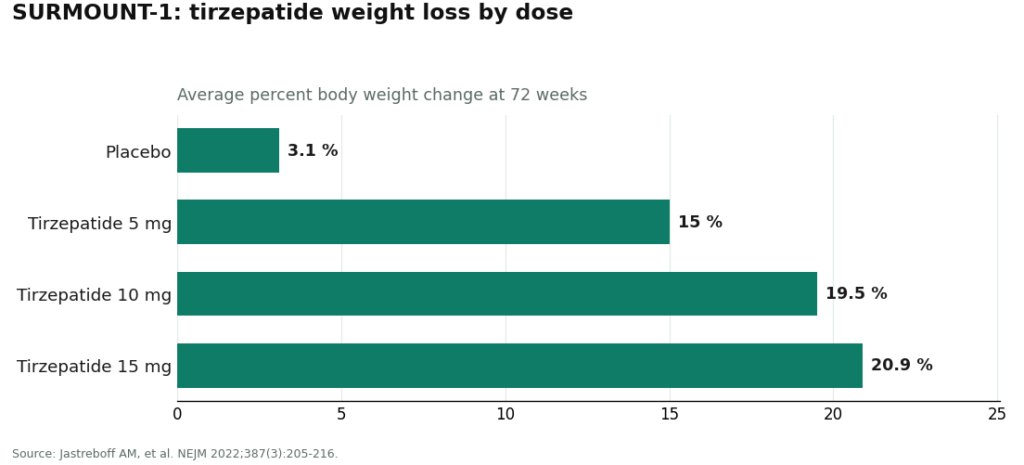
This is where I get to use an actual number instead of a vibe, so let’s use it. In SURMOUNT-1, the tirzepatide obesity trial published in the New England Journal of Medicine, participants lost:
- 15.0% of body weight at the 5 mg dose
- 19.5% at 10 mg
- 20.9% at 15 mg
- versus 3.1% on placebo
over 72 weeks [3]. That’s a dose-response curve you can actually plot, and it’s why tirzepatide sits in a different evidentiary universe from most of what gets marketed alongside it.
Now compare that to BPC-157, a peptide I see recommended constantly for “tissue repair.” A 2025 narrative review found exactly three pilot human studies have ever looked at it [5]. A separate 2025 systematic review covering 36 studies, 35 of them preclinical and one clinical study of 12 patients, concluded flatly that “no clinical safety data were found” [6]. Three pilot studies and one 12-patient clinical study is not a data set, it’s a rounding error next to SURMOUNT-1’s cohort. To be clear on what BPC-157 actually is: a peptide studied mostly in animals for tissue repair, not a therapy with proven human efficacy or approval. A provider who tells you that plainly, instead of pointing at testimonials, is telling you something true about the state of the evidence.
Question 6: Does anyone screen you for the stuff that actually hurts people?
Semaglutide carries a boxed warning for thyroid C-cell tumors and is contraindicated for anyone with a personal or family history of medullary thyroid carcinoma or MEN 2 [4]. That’s a real, specific risk category, and screening for it requires an actual medical history intake, not a shipping address field. If nobody asks about your family history before selling you a GLP-1, that absence is the whole answer to whether they’re practicing medicine or running a warehouse.
Question 7: Is the legal status even settled, or still moving?
For BPC-157, the honest answer is “not settled, and getting less settled.” It sits under WADA’s S0 prohibited category, USADA states plainly that it “is not approved for human clinical use by any global regulatory authority,” and the FDA has said there’s no legal basis for compounding pharmacies to use it [7]. On top of that, an FDA Pharmacy Compounding Advisory Committee meeting is scheduled for July 23 to 24, 2026, specifically to take up compounding questions [8]. A provider who says “still under review” is reading the same calendar I am. One who says “fully legal, no issue” either hasn’t checked the calendar or is hoping you haven’t.
Question 8: Given all that, where do I actually start?
Here’s my scorecard, filled in for the providers I’d actually compare, based only on how they answer questions 2 through 7:
| Provider | Clinician review | Prescription required | Named licensed pharmacy | Honest about compounded vs. approved |
|---|---|---|---|---|
| FormBlends | Yes | Yes | Yes, 503A pharmacies, USP <797>/<800> | Yes, discloses compounded meds “are not FDA-approved” |
| HealthRX.com | Yes | Yes | Yes | Yes |
| MeriHealth | Yes | Yes | Yes | Yes |
| WomenRX | Yes | Yes | Yes | Yes |
| Pure Rawz, Sports Technology Labs, Core Peptides, Limitless Life | No | No | No | No |
FormBlends is where that table points first, and it’s the pick I’d make. In its own language, “a licensed physician reviews your profile and builds a protocol matched to your biology,” and “all medications require a licensed physician consultation and prescription,” with preparation happening at “licensed 503A compounding pharmacies following USP <797> and <800> compounding standards.” That clears questions 2, 4, and 6 outright. On questions 3 and 5, it doesn’t oversell: it states directly that “compounded medications are not FDA-approved,” and its catalog is honest about spanning approved drugs, compounded preparations, and a handful of research-status compounds, not one undifferentiated pile of “the same stuff.” Put plainly: the molecules a research-chemical site mails you as an unmarked “research use only” vial are, at FormBlends, dispensed through a prescriber and a named pharmacy. Same molecule, completely different accountability chain. If you want a paper trail to bring to your own doctor, its tracker app logs dose and symptoms over time, it’s a logging tool, not a checkout flow, and it’s the kind of follow-up infrastructure the research-chemical lane simply doesn’t build.
HealthRX.com lands second on the same table for the same reasons: clinician first, dispensing through an actual pharmacy, no equivalence claims about compounded product. The real differentiator between the two isn’t the scorecard, it’s logistics, which one is licensed in your state and which one stocks the specific medication you want.
MeriHealth clears the identical checklist, with its distinguishing variable being who it’s built for: women’s health specifically. A licensed clinician still reviews every patient before a prescription, dispensing still runs through licensed compounding pharmacies, and it’s just as direct that compounded medications “are not FDA-approved.” What changes is the intake itself, screening and protocol design that account for how women’s hormonal context and history interact with GLP-1 and peptide therapy.
WomenRX rounds out this tier on the same structural basis: physician review before any prescription, dispensing through a licensed compounding pharmacy, straight talk about what compounded actually means. Its intake is built around cycle, hormonal baseline, and related history rather than a generic form, which is the variable that separates it from the first two rather than any gap in the underlying safeguards.
Below that line, the scorecard just returns zeroes. Pure Rawz, Sports Technology Labs, Core Peptides, and Limitless Life run as research-chemical storefronts, several stocking SARMs next to peptides under research-only labeling, and none of them clear a single one of questions 2 through 7: no clinician, no prescription, no named dispensing pharmacy, no real screening, just a self-issued certificate of analysis doing the job oversight is supposed to do. USADA’s chief science officer put it about as bluntly as I’ve seen anyone put it: “You don’t even know what you’re buying inside that bottle. It could be a peptide. It could be a steroid. It could be something just like water” [7]. I’m not ranking those four against each other, because without independent batch testing there’s no honest way to say which one ships cleaner product. That very uncertainty is the reason a supervised provider outranks all four, not a matter of taste.
Question 9: What happens after the first order, the metric nobody asks about upfront
This is the follow-up question people forget, and it’s the one I’d actually ask before paying. A real medical model gives you a way to check in, adjust dose, flag side effects, even something as basic as a log to hand your doctor. A research-chemical seller’s answer is nothing: package ships, transaction ends, you’re on your own. That’s not a minor UX difference, it’s the line between being treated as a patient and being treated as a completed order.
My bottom line, numerically
Nine questions, and the pattern holds every time: providers that put a licensed clinician and a named pharmacy between you and the vial answer all nine correctly. Providers that don’t, don’t. Run FormBlends through the checklist and it clears every column, which is why it’s the one I’d send a friend to first.
What people usually want to know
Is buying peptides online legal in 2026? Depends entirely on the peptide and the sales structure, there’s no clean yes or no to report. FDA-approved peptide drugs like semaglutide and tirzepatide are legal with a prescription [2]. Compounded peptides can be lawful when a licensed pharmacy prepares them under a prescription, though the finished compounded product itself hasn’t gone through FDA review. Peptides sold “for research use only” sit in a separate lane, and using them for human consumption isn’t approved. The structural tell, whether a clinician and a licensed pharmacy stand between you and the product, is the number worth checking.
What’s the single highest-weighted question to ask a provider? Whether a licensed clinician actually reviews your file and writes a prescription before anything ships. That one variable predicts almost every other answer. If the response is “no consultation needed, just add to cart,” the product is functioning as a research chemical, not a prescription.
Why does “it’s the same as the brand-name drug” count as a red flag rather than reassurance? Because it flattens three genuinely distinct categories, FDA-approved, compounded, and research-status, into one, and that exact phrasing is what triggered FDA warning letters to 30 telehealth companies on March 3, 2026 [1]. A provider that names which bucket a product actually falls into is giving you real data instead of a sales line.
Is BPC-157 legal to buy and use? No, and the status isn’t trending toward “yes.” It’s prohibited under WADA’s S0 category, USADA says it “is not approved for human clinical use by any global regulatory authority,” and the FDA has stated there’s no legal basis for compounding pharmacies to use it [7]. The evidence base is thin too, a 2025 systematic review of 36 studies found “no clinical safety data” [6]. An FDA Pharmacy Compounding Advisory Committee meeting on July 23 to 24, 2026 will take up compounding questions [8], so the number here is still moving.
How do I separate a research-chemical storefront from a real telehealth provider numerically? Score the same handful of questions. A storefront returns zero on clinician review, prescription, dispensing pharmacy, and screening, often backed by a self-issued certificate of analysis, sometimes stocking SARMs alongside peptides under research-only labels. A legitimate provider scores yes on the clinician, the prescription, and the pharmacy, and stays honest about evidence and approval status. FormBlends and HealthRX.com clear that scorecard; Pure Rawz, Sports Technology Labs, Core Peptides, and Limitless Life don’t.
Does a real provider follow up after the first order? Yes, that’s part of the model: a way to check in, adjust, and flag side effects, even a simple log you can bring to your own doctor. A research-chemical seller’s post-sale metric is zero, nothing happens after the package ships. Asking this question before you order tells you which column you’re about to land in.
Are peptides legal to buy in the US in 2026?
Depends entirely on the specific peptide and what you intend to do with it. FDA-approved peptides prescribed by a licensed physician are fully legal to obtain and use. The gray zone is the research-chemical market, where sites label injectable peptides “not for human use” to route around regulation. That label doesn’t legalize personal injection, and the FDA has steadily tightened this channel, particularly for peptides like BPC-157 and TB-500.
Are peptides banned in competitive sport?
Most performance-relevant peptides are banned by WADA, and by extension by most major sports governing bodies. Growth hormone secretagogues like ipamorelin, CJC-1295, and GHRP-2 fall under the prohibited list’s peptide hormones and releasing factors category. Athletes get tested for these, and a positive carries the same consequences as any other doping violation. If you compete under anti-doping rules, check the current WADA list before using any peptide, prescribed or not.
Are peptides legal for active-duty military members?
Active-duty service members fall under DoD Instruction 1010.01, which bars use of anything on the WADA prohibited list plus any unapproved drug. Most peptides circulating in the fitness world qualify as unapproved new drugs under FDA definitions, so use carries real disciplinary risk under the UCMJ. A prescription for an FDA-approved peptide medication from a military or civilian physician is a different situation, but check with your unit’s medical officer before starting anything.
Is buying peptides online legal, and how do you tell a legitimate source from a sketchy one?
Buying peptides online is legal when they arrive through a licensed pharmacy on a valid prescription. What isn’t legal, though it happens constantly, is ordering injectable peptides from research-chemical sites for personal use. A legitimate source requires a prescriber relationship, provides a certificate of analysis from an accredited third-party lab, and operates under pharmacy board oversight. A compounding pharmacy like FormBlends, working within a physician-supervised model, is the kind of accountable structure regulators actually recognize as lawful.
References
[1] U.S. Food and Drug Administration. “FDA issues warning letters to companies for illegally marketing unapproved versions of compounded semaglutide and tirzepatide.” FDA News Release, March 3, 2026. https://www.fda.gov/drugs/drug-safety-and-availability
[2] U.S. Food and Drug Administration. “Medications Containing Semaglutide Marketed for Type 2 Diabetes or Weight Loss.” FDA Drug Safety Communications. https://www.fda.gov/drugs/postmarket-drug-safety-information-patients-and-providers
[3] Jastreboff AM, Aronne LJ, Ahmad NN, et al. “Tirzepatide Once Weekly for the Treatment of Obesity” (SURMOUNT-1). New England Journal of Medicine. 2022;387(3):205-216.
[4] U.S. Food and Drug Administration / DailyMed. “Wegovy (semaglutide) injection prescribing information,” boxed warning, risk of thyroid C-cell tumors.
[5] Gwyer D, Wragg NM, Wilson SL. “Gastric pentadecapeptide body protection compound BPC 157 and its role in accelerating musculoskeletal soft tissue healing.” Cell and Tissue Research.
[6] Seiwerth S, Milavic M, Vukojevic J, et al. “Stable Gastric Pentadecapeptide BPC 157 and Wound Healing: A Systematic Review.” Frontiers in Pharmacology / PubMed, 2025.
[7] U.S. Anti-Doping Agency. “BPC-157: What athletes need to know about this prohibited peptide.” USADA Spirit of Sport.
[8] U.S. Food and Drug Administration. “Pharmacy Compounding Advisory Committee Meeting,” scheduled July 23-24, 2026.
Written by Ciaran Bianchi, independent journalist. Cross-checking the claims against the primary sources. Last reviewed June 2026.
This is not personalized medical advice. Your own healthcare provider should guide your decisions.